People look for a Quizlet alternative for two reasons. Some hit a paywall on the features they used most. Others have a big exam coming and find that flipping cards is not the same as learning a whole syllabus. This guide starts with what the research says a study app needs to do, then compares Anki, RemNote, Brainscape and CramClip against Quizlet itself, with prices checked on each company's own page as of October 15, 2026. It also says when staying on Quizlet is the right call, and who should not use CramClip at all.
What a good Quizlet alternative has to do
Before comparing apps, it helps to know what actually makes studying work. Three findings carry most of the weight.
Retrieval beats rereading
In a well-known experiment, Roediger and Karpicke had students read a short prose passage and then either reread it or try to recall it from memory. Tested five minutes later, the rereaders did best. Tested a week later, the picture flipped: the group that studied once and recalled three times remembered 61% of the ideas, against 40% for the group that read it four times. The rereaders had read the passage far more often and felt more confident they would remember it. They were wrong.
Tested after 5 minutes
Tested after 1 week
Spacing beats cramming
A meta-analysis by Cepeda and colleagues pooled 839 assessments from 317 experiments. Spreading study sessions apart beat massing them together, and the further away the test, the longer the best gap between sessions.
Only two techniques rated high
Dunlosky and colleagues reviewed ten common study techniques in 2013. Only practice testing and distributed practice earned their highest utility rating. Rereading, highlighting and summarizing were rated low.
So any app worth switching to should do three things: make you retrieve, bring material back over days and weeks, and fit into the time you actually have. A good spaced repetition app covers the first two. The third depends on your life.
Quizlet alternatives compared at a glance
Prices are from each company's own page as of October 2026. Quizlet's pricing page did not load for our checker, so we link it instead of quoting a number we could not confirm.
| App | Best for | How reviews are scheduled | Makes material from your files | Platforms | Price |
|---|---|---|---|---|---|
| Quizlet | Ready-made sets, classes | Spaced repetition (per its App Store listing) | Yes, from notes and recordings | Web, iOS, Android | Free app; Quizlet Plus is paid (see quizlet.com/upgrade) |
| Anki | Memorizing large volumes of facts | SM-2 by default, FSRS optional | No, you build or import cards | Desktop, Android, iOS, web | Free; AnkiMobile for iOS $24.99 one time |
| RemNote | Notes and cards in one place | Spaced repetition on your cards | Yes, AI cards from PDFs on Pro with AI | Desktop, web, iOS, Android | Free; Pro $8/month; Pro with AI $18/month |
| Brainscape | Simple decks, confidence ratings | You rate 1 to 5; low ratings return sooner | AI-made cards; unlimited on Pro | Web, iOS, Android | Free; Pro listed at $7.99/month |
| CramClip | Learning an exam syllabus by ear | Missed quiz items return on day 1, 3, 7, 14 | Yes, an audio course from a PDF | iOS | First lesson free; Pro $8.99/week, $17.99/month, $119.99/year |
The Quizlet alternatives, one by one
Anki: the power tool
Anki is the original serious flashcard app, and for many people it is the Quizlet alternative they end up keeping. Desktop Anki, AnkiDroid on Android and AnkiWeb sync are free. AnkiMobile on iOS costs $24.99 once, and Anki's site notes that those purchases fund development. By default it schedules with the long-standing SM-2 algorithm; you can switch on FSRS, a newer scheduler, in the deck options.
Anki is the best choice for long-term memorization at volume: medical school, languages, any exam that rewards thousands of discrete facts. The cost is setup. You build cards or import shared decks, and the settings have a learning curve.
If you are looking for an Anki alternative, it is usually because you do not want to make cards, or because your problem is not remembering facts you already understand but learning the material in the first place.
RemNote: notes and cards together
RemNote combines a note-taking app with flashcards, so cards come out of the notes you are already writing. The free plan includes unlimited notes and cards, three annotated documents and a small number of AI-generated cards. Pro is $8 a month or $96 a year. Pro with AI, which makes flashcards and quizzes from your PDFs, is $18 a month or $216 a year. It suits students who take structured notes and want cards built inline, and it is the Quizlet alternative closest to a full notebook.
Brainscape: confidence-based repetition
Brainscape asks you to rate each card from 1 to 5 for how confident you feel. Low ratings bring the card back sooner; high ratings push it further out. The basic plan is free, and Pro is listed at $7.99 a month, though the page does not make the billing term clear, so check before you pay. It suits people who want a simple interface and ready-made decks.
CramClip: learning an exam syllabus by ear
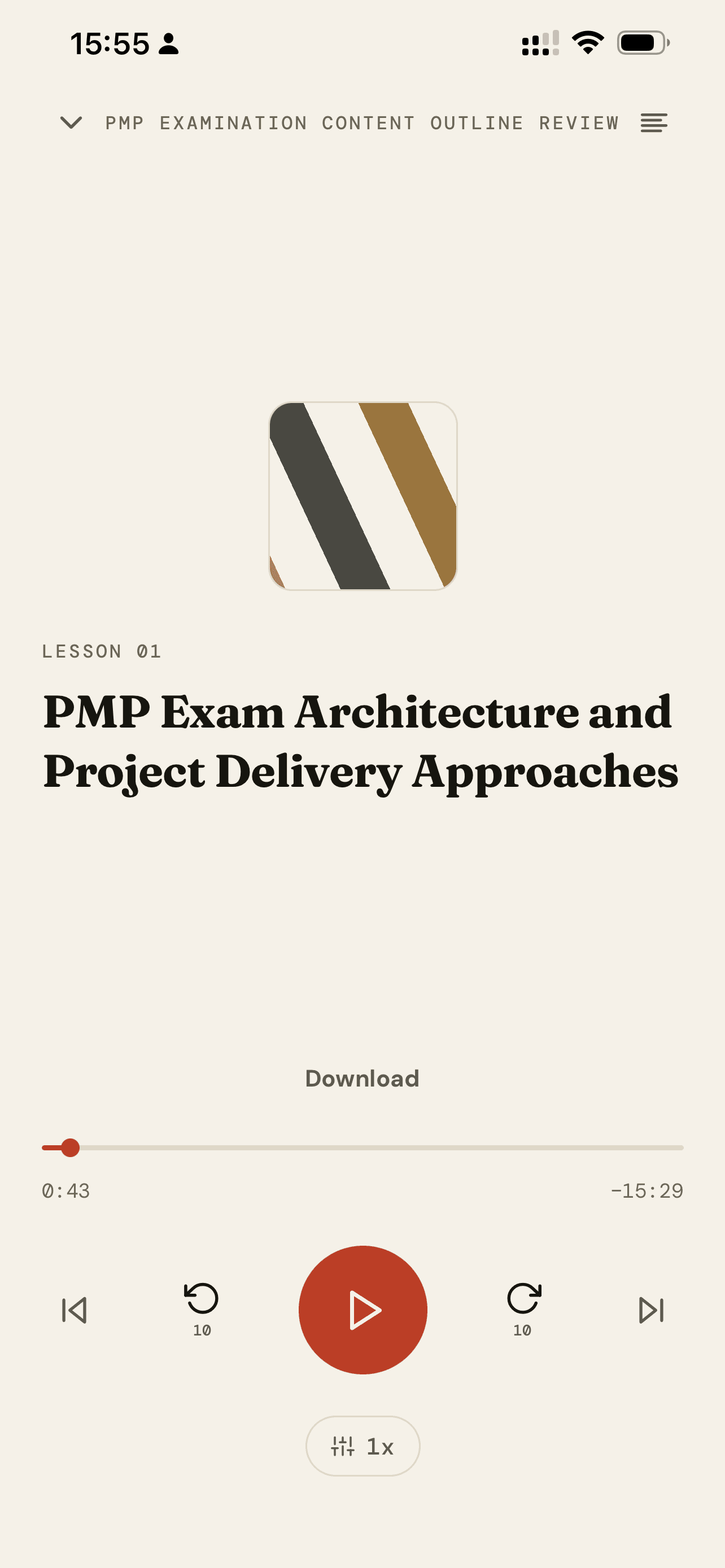
CramClip is not a flashcard app, so it is a Quizlet alternative only for one job: learning the material for a dated exam. It is a different shape of tool. You upload a PDF of up to 300 pages, paste notes, or add a link, and it builds a course of 4 to 20 two-host audio lessons, each 15 to 22 minutes. The material is reorganized and compressed for teaching, not read aloud. Each lesson ends with four multiple-choice questions with explanations.
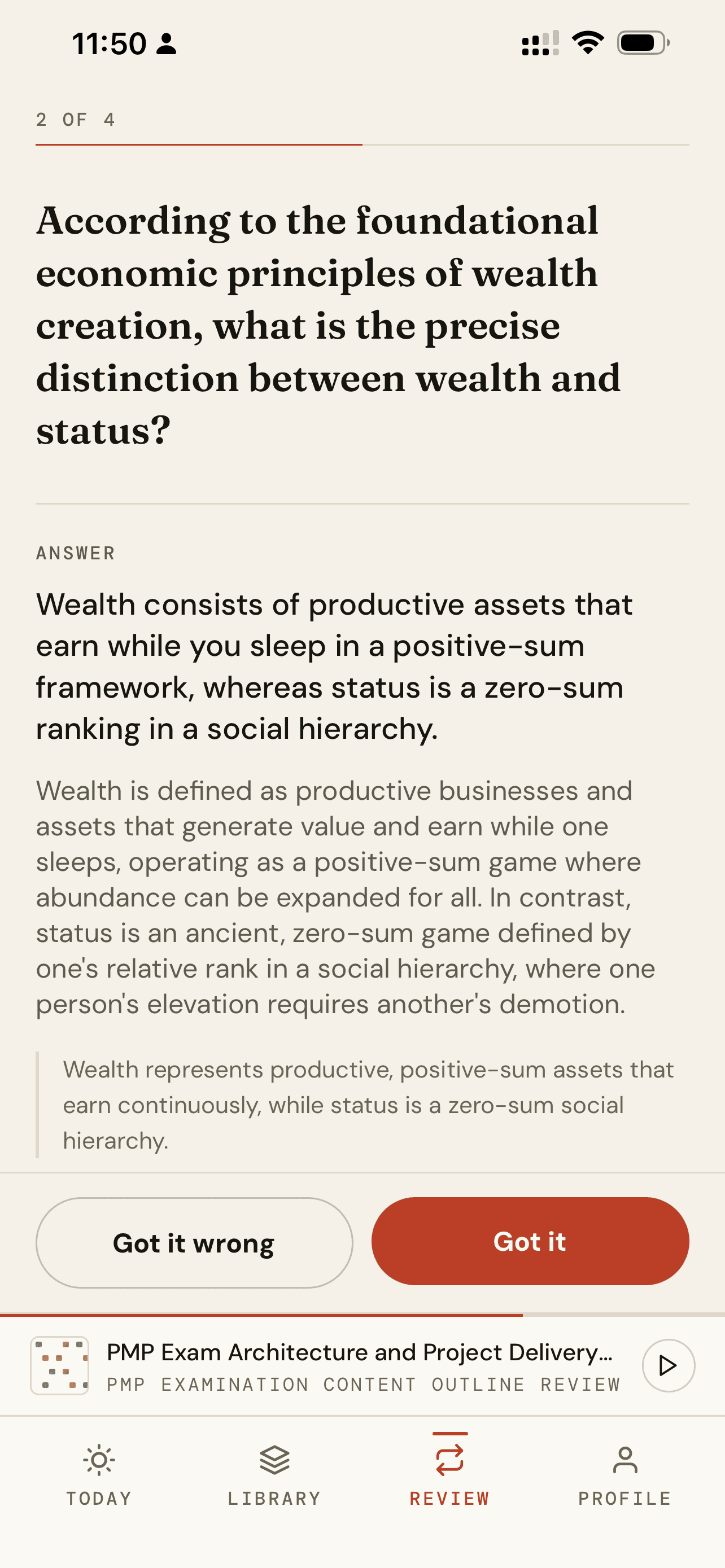
Anything you miss becomes a review card. You see the question, reveal the answer and explanation, and mark whether you got it. Cards follow a fixed schedule. Get it right and the card moves to the next step; miss it and it starts again at day one. At most 20 cards come up a day.
- Day 1The missed question comes back the next day.
- Day 3Right again? It waits a little longer.
- Day 7A week out.
- Day 14Then it graduates. A miss at any step resets to day 1.
Set an exam date and the Today screen tells you how many lessons to finish each day. CramClip suits exam candidates with a date and time they cannot spend at a desk, such as a commute or the gym. Our NCLEX study plan and PMP exam content outline guides show what that looks like for two exams.
Staying on Quizlet
Sometimes the best Quizlet alternative is Quizlet. It is not standing still, and it is fair to say so. Its App Store listing now describes study sets built from uploaded notes, lecture recordings turned into flashcards, conversational audio podcasts from your notes, practice tests and spaced repetition. It also has a huge library of sets made by other students, classes for teachers, and an interface millions already know. If your class runs on Quizlet, or you mostly need ready-made sets, staying is reasonable. Before you leave over price, check the current plans at quizlet.com/upgrade.
Who should not use CramClip
We would rather you pick the right tool than the wrong one. Skip CramClip if:
- You want to write your own flashcards. CramClip has no card editor, and you cannot import Quizlet sets or Anki decks.
- You need to memorize thousands of discrete facts. Its review queue holds only the quiz questions you missed, not everything you need to know. Use Anki.
- You want an adaptive scheduler. CramClip uses a simple fixed schedule, not an algorithm like FSRS.
- You are on Android, the web or a desktop. It is iOS only for now; Android is coming.
- You study in a language other than English. It is English only.
- You teach a class. It has no shared sets, live games or classroom features.
- You want a long free plan. The free tier is one full lesson, with its quiz and review cards.
Which Quizlet alternative should you pick?
Match the tool to the job, not to a ranking.
- "I need to memorize thousands of facts for years." Anki.
- "I take notes and want cards made from them." RemNote.
- "I want ready-made decks with little setup." Brainscape, or stay on Quizlet.
- "My class uses Quizlet." Stay on Quizlet.
- "I have an exam date, a stack of PDFs and no desk time." CramClip, paired with a question bank or flashcard app if your exam needs heavy fact drilling.
Plenty of people use two of these. A common pairing is an audio course for the commute and a flashcard app at the desk. The best Quizlet alternative for you is the one you will still be opening three weeks from now.
Frequently asked questions
What is the best free Quizlet alternative?
For spaced repetition, Anki is free on desktop, Android and the web. RemNote has a free plan for notes and flashcards. The right one depends on whether you want to build cards or take notes.
Is Anki better than Quizlet?
For long-term retention of many facts, Anki gives you more control over scheduling, including the optional FSRS algorithm. Quizlet is easier to start with and has far more ready-made sets.
What is a spaced repetition app?
An app that brings material back for review at growing intervals, based on research showing that spaced study beats cramming. Anki, RemNote, Brainscape, Quizlet and CramClip all schedule reviews in different ways.
Can I import my Quizlet sets into CramClip?
No. CramClip builds audio courses from PDFs, pasted text or links. It does not import or create flashcard decks.
Does listening to study audio work?
Listening alone is similar to rereading. It works best when followed by retrieval practice and spaced review, which is why CramClip ends every lesson with a quiz and schedules what you miss.
Sources
- Roediger, H. L., & Karpicke, J. D. (2006). Test-enhanced learning: Taking memory tests improves long-term retention. Psychological Science, 17(3), 249–255.
- Cepeda, N. J., et al. (2006). Distributed practice in verbal recall tasks. Psychological Bulletin, 132(3), 354–380.
- Association for Psychological Science. Which study strategies make the grade? (on Dunlosky et al., 2013).
- Quizlet. Quizlet: More than Flashcards on the App Store and Quizlet plans.
- Anki. Anki apps, Deck options and FSRS and AnkiMobile on the App Store.
- RemNote. Pricing.
- Brainscape. Pricing and Confidence-based repetition.