
Good PMP exam prep starts with the right version of the exam. Since July 2026, the PMP has 180 questions in 240 minutes, built on a new content outline weighted People 33%, Process 41% and Business Environment 26%. To sit it, you need 35 hours of project management training and between 24 and 60 months of experience leading projects, depending on your education. This guide covers the format, eligibility, the application and audit, what to check about cost, and an 8-week study plan for people with a full-time job. Facts come from PMI's July 2026 exam content outline and its Certification Handbook (revised June 2026), checked on October 15, 2026.
The PMP exam at a glance
| Item | July 2026 exam |
|---|---|
| Questions | 180, of which 170 are scored and 10 are unscored pretest items |
| Time | 240 minutes; the optional tutorial and survey are not counted |
| Breaks | Two 10-minute breaks; no going back to a section once its break starts |
| Question types | Case or scenario sets, graphic-based, multiple choice, multiple response, matching and more |
| Delivery | Pearson VUE test center or OnVUE online proctoring; paper-based only in mainland China |
| Domains | People 33%, Process 41%, Business Environment 26% |
| Approach mix | About 40% predictive, about 60% agile or hybrid |
| Eligibility window | 1 year from approval, up to three attempts |
| Renewal | 60 PDUs every 3 years, plus a renewal fee |
The first break comes after the case-study section. The second comes about halfway through the independent questions. Once you review your answers and start a break, the questions before it are locked.
Are you eligible for the PMP?
PMI checks three things: your education, months spent leading projects, and 35 hours of project management training. You record all three in the online application.
Experience: four tiers, all within 10 years
The July 2026 outline maps education to international framework levels. The more formal education you have, the less experience PMI asks for.
Three rules trip people up. The experience must fall within the 10 years before you apply. It must be experience leading projects, not just working on them. And months cannot overlap. PMI's own example: one project from January to March and another from February to May count as five months, January through May, not seven.
The 35 training hours
You need at least 35 hours of project management training aligned to the exam content outline. PMI accepts courses from seven kinds of provider: Authorized Training Partners, China Registered Education Providers, GAC-accredited programs, accredited universities, employer programs, training companies, and self-paced on-demand courses that end with an assessment. Books and practice exams alone do not count.
If you hold an active CAPM, the 35-hour requirement is waived; our CAPM exam prep guide covers that exam. Course Report reports that from late Q4 2026, instructor-led hours will count only when delivered by an Authorized Training Partner or an eligible academic program, with self-paced courses still accepted from any eligible provider. PMI's outline does not say this yet, so check with PMI before you pay for a live course.
Application and audit
Any application can be picked for a random audit, and you hear about it before you pay. You then have 90 days to send copies of your diploma, signatures from the supervisors on your listed projects, and certificates for your training. A complete audit takes about 5 to 7 business days. Your one-year eligibility period starts on approval, or once you pass the audit. Fail or ignore an audit and you face a one-year suspension. It is worth collecting supervisor contacts and training certificates before you apply, so an audit costs you days rather than weeks of PMP exam prep time.
- ApplyRecord education, experience and 35 training hours.
- Audit, if picked90 days to send documents; review takes 5 to 7 business days.
- Pay and scheduleYour one-year window and three attempts begin.
- Sit the exam180 questions in 240 minutes, two breaks.
- Renew60 PDUs every three years.
What your PMP exam prep needs to cover
Every exam covers all 26 tasks in the July 2026 outline, so your prep has to as well: eight in People, ten in Process and eight in Business Environment. Business Environment grew from 8% to 26%, mostly because risk, change control, governance and compliance moved there from Process. Our PMP exam content outline guide lists every task and what changed.
Two new item types change how you should practice. Case or scenario sets hang several questions off one situation, so practice holding a scenario in your head. Graphic-based questions ask you to read charts, so get quick at reading earned value curves and burndown charts, not just reciting formulas. Our PMP formulas cheat sheet has a worked example for each.
What the PMP costs
We could not confirm current exam fees on pmi.org, and third-party sites disagree, so we do not print a number here. Check PMI's PMP page for the current member and non-member prices. Two rules from PMI's handbook are fixed, though. The member price applies only if your membership is active before you pay for the exam. And rescheduling or canceling within 30 days of your appointment costs US$70, while inside 48 hours you forfeit the whole exam fee.
An 8-week PMP study plan
This PMP study plan assumes 8 to 10 hours a week, or roughly 64 to 80 hours. That is our planning assumption, not a PMI figure; adjust it to your starting point. Hours follow the domain weights, with the last two weeks kept for formulas, scenarios and full mocks.
| Week | Focus | Hours |
|---|---|---|
| 1 | Read the outline, take a diagnostic mock, mark weak tasks | 8 |
| 2 | Process: planning, scope, schedule, resources | 10 |
| 3 | Process: procurement, finance, quality, status, closure | 10 |
| 4 | People: vision, conflict, leading the team | 9 |
| 5 | People: stakeholders, knowledge transfer, communication | 9 |
| 6 | Business Environment: governance, compliance, change, risk | 10 |
| 7 | Earned value and agile metrics; hybrid scenario practice | 10 |
| 8 | Two timed full mocks; review every miss by task | 10 |
A daily rhythm that fits a workday
Most candidates fit PMP exam prep around a job. A plan that needs two quiet hours at a desk every evening tends to slip by week three. Split the day instead. On the commute, listen to one lesson of about 15 to 22 minutes. Then answer four questions on it while it is fresh. Spend 10 to 15 minutes on review cards before bed. Keep weekend mornings for timed question blocks at a desk.
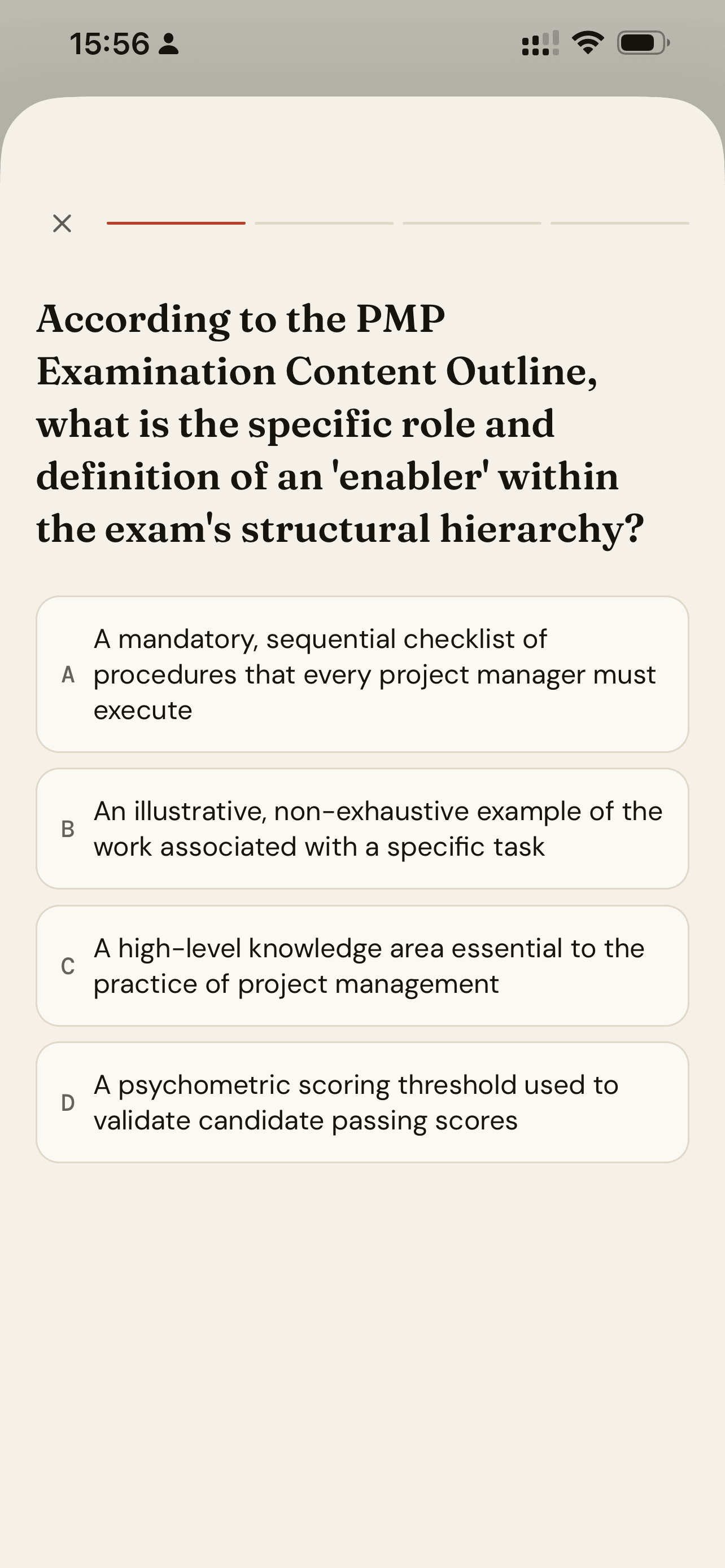
CramClip is built for that rhythm. Upload your prep-course PDF, the exam content outline or your own notes, and it turns them into a series of two-host audio lessons. Each lesson ends with a four-question quiz. Anything you miss comes back as a review card one, three, seven and fourteen days later. Set your exam date and the Today screen works out how many lessons you need each day to finish in time.
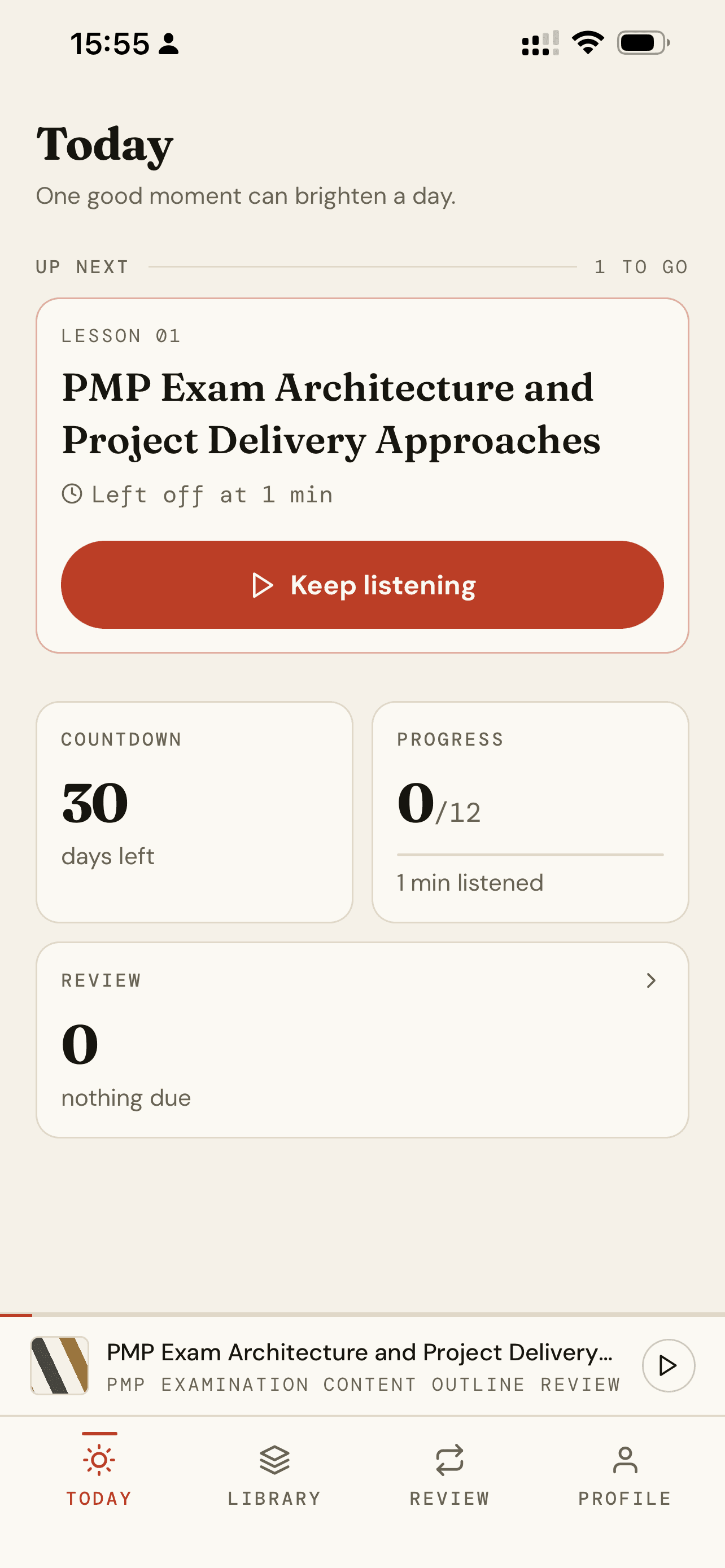
Be clear about what it is not. CramClip teaches from the material you upload. It is not a PMI course, it does not count toward your 35 training hours, and it does not include a question bank or full-length mock exams. iOS only for now; the first lesson is free.
How to use a PMP practice exam
Practice exams are where PMP exam prep gets honest. Take a diagnostic in week 1 so you know where to spend time, not to judge yourself. In week 8, sit at least two full 180-question mocks under real conditions: 240 minutes, two 10-minute breaks, no going back after a break.
Review every miss, and every lucky guess, against the outline task it belongs to. A cluster of misses on one task means returning to the lesson, not drilling more questions on it. Look for mocks that include case sets and charts, since a bank written for the 2021 exam will not prepare you for the new formats.
After you pass: keeping your PMP
The PMP lasts three years. To renew, you earn 60 professional development units in that cycle through PMI's Continuing Certification Requirements program and pay a renewal fee. Start logging PDUs early so the last year is not a scramble. Many of the habits from your prep, such as listening during the commute, work just as well for the ongoing learning that renewal asks for.
Frequently asked questions
How many questions are on the PMP exam in 2026?
There are 180 questions, 170 scored and 10 unscored pretest items, with 240 minutes to answer them and two 10-minute breaks.
How much does the PMP exam cost?
Prices depend on PMI membership and region. Check the current figure on the PMP page at pmi.org before you pay, and join PMI first if you want the member rate.
Can I take the PMP without a degree?
Yes. With a secondary school diploma you need 60 months of experience leading projects in the past 10 years, plus 35 hours of project management training.
How many times can I retake the PMP?
You get up to three attempts in your one-year eligibility period. After three fails, you wait one year from your last attempt before reapplying.
How long should I study for the PMP?
PMI does not publish a figure. Our plan uses 8 weeks at 8 to 10 hours a week. Spend longer if your diagnostic mock shows several weak domains.
Sources
- PMI. Project Management Professional (PMP) Examination Content Outline – July 2026.
- PMI. Certification Handbook, revised June 2026.
- PMI. Continuing Certification Requirements Handbook.
- PMI. Project Management Professional (PMP) certification (current fees).
- Course Report. What's changing on the PMP exam in July 2026.