CAPM exam prep is more manageable than it looks once you know the shape of the test. The CAPM has 150 questions in 3 hours, spread across four domains: Project Management Fundamentals and Core Concepts (36%), Business Analysis Frameworks (27%), Agile Frameworks and Methodologies (20%) and Predictive, Plan-Based Methodologies (17%). To sit it you need a secondary school diploma and 23 hours of project management education. One thing to clear up first: the CAPM did not change in July 2026. That change was to the PMP. The CAPM still runs on PMI's 2023 exam content outline. This guide covers the format, eligibility, every domain and task, and a 6-week study plan, all checked against PMI's own documents on October 15, 2026.
The CAPM exam at a glance
| Item | Current CAPM exam |
|---|---|
| Content outline | PMI CAPM Examination Content Outline, 2023 exam update |
| Questions | 150, of which 135 are scored and 15 are unscored pretest items |
| Time | 3 hours; the optional tutorial and survey (5 to 15 minutes) are not counted |
| Break | One 10-minute break after question 75; no going back after it |
| Question types | Multiple choice, drag and drop, animations and comic strips, possibly hot spot |
| Eligibility | Secondary diploma plus 23 hours of project management education |
| Eligibility window | 1 year, up to three attempts |
| Renewal | Every 3 years, with 15 PDUs |
Pretest questions are mixed in at random, so treat every question as if it counts. Animation items come with headphones at a test center. If you test online, you see comic strips instead, so there are no audio issues.
Who is eligible, and what counts as the 23 hours
You need a high school diploma, GED or global equivalent, and 23 contact hours of project management education. There is no experience requirement, which is the main reason students and career changers start here.
The 23 hours can come from self-study guides, courses, workshops or training sessions offered by any of these: PMI Authorized Training Partners, PMI chapters, employer programs, training companies or consultants, distance-learning companies whose courses end with an assessment, and university or college programs. Chapter meetings do not count, unless at least an hour of a meeting is a learning activity. The hours must be finished by the time you take the exam, not when you apply. PMI lists topics such as quality, scope, time, cost, resources, communications, risk, procurement, integration, agile and business analysis.
PMI aims to process registrations within 24 hours. That timeline does not apply if your registration is picked for an audit, in which case you will need certificates for your education hours.
What's on the CAPM: the four domains
The CAPM exam content outline lists four domains and 19 tasks. PMI says every exam covers all tasks and keeps to the domain percentages. Predictive, agile and business analysis ideas also appear across all four domains, not only in their own.
Fundamentals and Core Concepts: 36%, 5 tasks
Project life cycles and processes, project management planning, project roles and responsibilities, following and executing planned strategies or frameworks, and common problem-solving tools and techniques. This is the foundation: the difference between a project, a program and a portfolio, what each part of a plan is for, and who does what.
Predictive, Plan-Based Methodologies: 17%, 3 tasks
When a predictive approach is appropriate, the project management plan schedule, and how to document project controls on predictive projects. It is the smallest domain, but predictive thinking also shows up in Fundamentals questions.
Agile Frameworks and Methodologies: 20%, 5 tasks
When an adaptive approach is appropriate, how to plan iterations, how to document controls on an adaptive project, the components of an adaptive plan, and how to prepare and execute task management steps. Expect questions on artifacts such as backlogs and on how different agile methods compare.
Business Analysis Frameworks: 27%, 6 tasks
Business analysis roles and responsibilities, stakeholder communication, gathering requirements, product roadmaps, how project methodologies shape business analysis, and validating requirements through delivery. It has the most tasks of any domain and carries more than a quarter of the score. The PMP outline has no business analysis domain, so prep material written mainly for the PMP may cover it only lightly. Plan dedicated time for elicitation techniques, user stories, acceptance criteria and traceability.
The outline's references include the PMBOK Guide, Seventh Edition, Process Groups: A Practice Guide, The PMI Guide to Business Analysis, Business Analysis for Practitioners and the Agile Practice Guide. Be cautious with prep material that claims to be built on a newer PMBOK edition; the CAPM outline has not been updated to match.
A 6-week CAPM exam prep plan
This CAPM study plan assumes about 6 to 8 hours a week. That is our assumption, not a PMI figure. If you are new to project management, add a week to Fundamentals. Time follows the domain weights, with Business Analysis getting a full week of its own.
| Week | Focus | Weight | Extra |
|---|---|---|---|
| 1 | Diagnostic quiz; life cycles, project vs program vs portfolio, planning | 36% | Mark weak tasks |
| 2 | Roles, planned strategies and frameworks, problem-solving tools | 36% | — |
| 3 | Predictive: when to use it, plan and schedule, controls | 17% | First 50-question set |
| 4 | Agile: when to use it, iterations, artifacts, task management | 20% | — |
| 5 | Business analysis: roles, elicitation, roadmaps, acceptance criteria | 27% | First full 150-question mock |
| 6 | Weak-domain repair, second full mock, light final two days | — | Review only in the last 48 hours |
- Week 1Diagnostic and Fundamentals part one.
- Week 2Fundamentals part two.
- Week 3Predictive, plus a 50-question set.
- Week 4Agile frameworks.
- Week 5Business analysis, plus a full mock.
- Week 6Fix weak domains, second mock, rest.
The daily rhythm
Each study day has three parts. Learn one topic, check it with a few questions while it is fresh, then spend ten minutes on the things you got wrong earlier in the week. Short, frequent sessions are easier to keep up around classes or a job than long weekend cram blocks, and the regular return to old mistakes is what moves them into long-term memory.
Mock exams are the part of CAPM exam prep that belongs at a desk. Sit the full 150-question mock in week 5 under real conditions: 3 hours, one break after question 75, no going back. Review every miss against its domain and task. A cluster of misses in one task means going back to the material, not just doing more questions.
Where CramClip fits
CramClip handles the daily part of this CAPM exam prep. Upload your 23-hour course workbook, the exam content outline or your own notes, and it maps them into a course of two-host audio lessons of 15 to 22 minutes each. Each lesson ends with four questions. Anything you miss comes back as a review card one, three, seven and fourteen days later. Set your exam date and it works out how many lessons to finish each day. Ask AI answers questions from your own document.
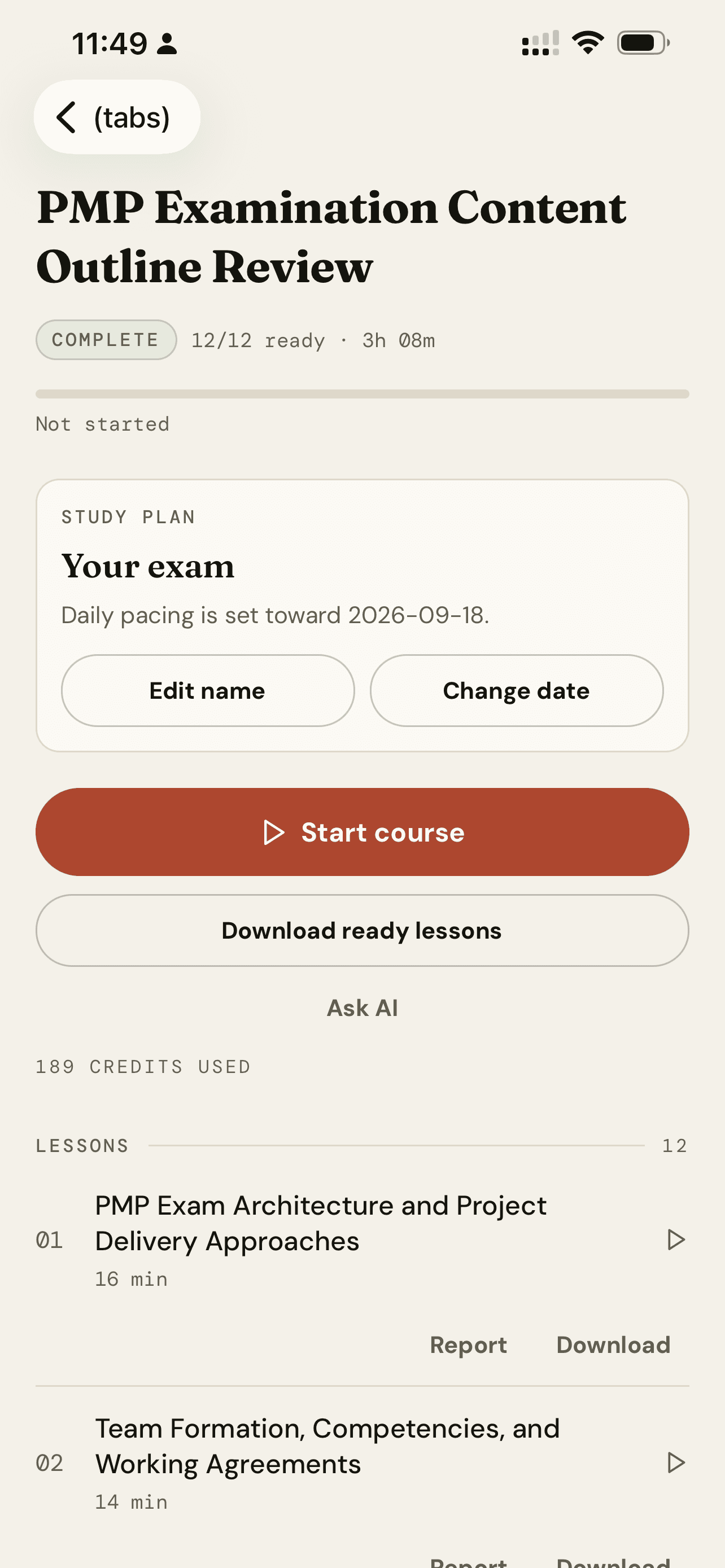
To be clear about its limits: CramClip is not a PMI course and does not provide your 23 education hours or a certificate for them. It has no CAPM question bank or full mock exams, so get those elsewhere. It is iOS only, and the first lesson is free.
CAPM vs PMP: which first?
The CAPM is for people early in their careers. It needs no project experience. The PMP needs 24 to 60 months of experience leading projects, depending on your education, plus 35 hours of training (see our PMP exam prep guide). It also has a different and newer outline, described in our PMP exam content outline guide.
The two connect in one useful way. Under PMI's July 2026 PMP outline, an active CAPM waives the PMP's 35-hour training requirement. If you expect to sit the PMP within a few years, earning the CAPM first means one less thing to document later. Keep it active, because the waiver applies only to current holders.
Exam day, cost and retakes
You have a one-year eligibility window and up to three attempts. After three unsuccessful attempts, you must wait a year from your last exam before you can reapply. Retakes within the window are discounted, subject to PMI's regional and membership pricing.
We could not confirm current CAPM fees on pmi.org, so we do not print them. Check PMI's CAPM page for the current member and non-member prices. The member rate applies only if your membership is confirmed before you pay. Rescheduling or canceling within 30 days of your appointment costs US$70, and within 48 hours you forfeit the fee.
Frequently asked questions
How many questions are on the CAPM exam?
There are 150 questions, 135 scored and 15 unscored pretest items, with 3 hours to answer them and one 10-minute break after question 75.
Did the CAPM change in 2026?
No. The current CAPM outline is the 2023 exam update. The July 2026 change applied to the PMP only.
What counts as the 23 hours of education?
Project management courses, workshops, training sessions or self-study guides from listed provider types, such as PMI Authorized Training Partners, universities, employers and training companies. They must be complete by exam day.
How much does the CAPM cost?
Prices depend on PMI membership and region. Check the current figure on the CAPM page at pmi.org, and join PMI before paying if you want the member rate.
How long should I study for the CAPM?
PMI does not publish a figure. Our plan uses 6 weeks at about 6 to 8 hours a week; add time if you are new to project management.
Sources
- PMI. CAPM Examination Content Outline, 2023 exam update.
- PMI. Certification Handbook, revised June 2026.
- PMI. Continuing Certification Requirements Handbook.
- PMI. Project Management Professional (PMP) Examination Content Outline – July 2026 (CAPM credit toward the 35 hours).
- PMI. Certified Associate in Project Management (CAPM) (current fees).