
This NCLEX study guide covers what the exam is, not just what to study. It explains how the computerized adaptive test decides when to stop, which item formats you will see, how scoring and the passing standard work, and what registration and retakes cost, including the fee change on February 1, 2027. Every number here was checked against NCSBN, the organization that writes the NCLEX, on October 15, 2026. If you want a week-by-week schedule built from the test plan weights, use our NCLEX study plan generator alongside this page.
The 2026 NCLEX test plan in brief
NCSBN publishes a separate test plan for the NCLEX-RN and the NCLEX-PN. Both organize the exam around eight client-need categories and give each a percentage range. A single exam can differ from a category's stated share by up to 3 points either way. The current plans took effect on April 1, 2026, and are based on a 2024 practice analysis of what new nurses actually do on the job.
If you studied from 2023 material, little has moved. The overall format stayed the same and so did the category percentages. The visible change is a rename: "Safety and Infection Control" is now "Safety and Infection Prevention and Control." NCSBN also rewrote the activity statements, the lists of tasks under each category, so read the new plan once even if your notes are recent. Be wary of any NCLEX study guide that still shows older ranges from before 2023.
We cover the full category table and how to turn it into weekly hours on the NCLEX study plan page, so this guide does not repeat it. What matters here is where the two exams differ.
NCLEX-RN vs NCLEX-PN: what is different
The RN and PN exams share the same adaptive engine, the same 85 to 150 item range and the same five-hour limit. The differences are in the weights and the passing standard.
The RN exam's largest category is Management of Care. The PN equivalent is Coordinated Care, and it carries more weight. The PN exam also gives more room to Psychosocial Integrity and less to Physiological Adaptation and pharmacology. The passing standards differ too: 0.00 logits for RN and −0.18 logits for PN. The next section explains what that unit means.
Management of Care / Coordinated Care
Safety & Infection Prevention and Control
Health Promotion & Maintenance
Psychosocial Integrity
Basic Care & Comfort
Pharmacological (& Parenteral) Therapies
Reduction of Risk Potential
Physiological Adaptation
How the computerized adaptive test works
Format is where most candidates have gaps, so this is the longest part of the NCLEX study guide. The NCLEX is a computerized adaptive test, or CAT. After each answer, the computer updates its estimate of your ability and picks the next item to match it, so it should feel neither easy nor impossible. You cannot skip an item or go back to change an earlier answer.
Every candidate answers at least 85 items and no more than 150. NCSBN's test plan spells out what a minimum-length exam contains: 52 items from the eight content categories, 18 items in three clinical judgment case studies of six items each, and 15 unscored pretest items. Pretest items look exactly like scored ones, so treat every item as if it counts. On top of the case studies, roughly 10% of items are stand-alone clinical judgment items.
The three stop rules
The exam ends under one of three rules, all set out in the test plan.
- The 95% confidence rule. This is the most common. Once you have answered the minimum, the exam stops as soon as the computer is 95% certain your ability is clearly above or clearly below the passing standard.
- The maximum-length rule. If your ability sits close to the standard, the exam runs to 150 items. The confidence rule is then set aside, and you pass if your final ability estimate is at or above the standard.
- The run-out-of-time rule. If time expires before 150 items, you fail if you have not answered the minimum. If you have, the exam is scored on your final ability estimate.
That puts one popular myth to rest. An exam that shuts off at 85 items does not mean you passed. NCSBN is explicit that the length of an exam is not an indication of the result: a short exam can be a clear pass or a clear fail.
Next Generation NCLEX item types
The Next Generation NCLEX, or NGN, launched on April 1, 2023. It measures clinical judgment with the NCSBN Clinical Judgment Measurement Model. Each case study has six items, one for each step of the model.
- Recognize cuesPick out what matters in the history, vitals and notes.
- Analyze cuesConnect those cues to the client presentation.
- Prioritize hypothesesRank what could be happening by urgency and risk.
- Generate solutionsSet expected outcomes and the interventions to reach them.
- Take actionCarry out the solution for the highest priority.
- Evaluate outcomesCompare what happened with what you expected.
The test plan says only that items come in "multiple item formats" and points to NCSBN's Candidate Tutorial for the details. NCSBN's NGN materials describe formats including multiple choice, multiple response (select all that apply, select a set number, and grouped options), matrix grids, drag-and-drop and drop-down cloze items, highlight items in text or tables, and the bow-tie. A bow-tie asks, in one item, for the condition the client is most likely experiencing, the actions to take and the parameters to monitor. NCSBN states there is no fixed share of any format on a given exam.
Items with more than one correct key earn partial credit under one of three methods. Plus/minus scoring adds a point for each correct choice and takes one away for each wrong one, with a floor of zero. Zero/one scoring gives a point for each correct choice and nothing for wrong ones. Rationale scoring applies to paired answers, such as a cause and its effect, where both halves must be right.
The fastest way to get comfortable with the formats is NCSBN's own material. NCLEX.com offers the Candidate Tutorial, an Exam Preview and a Sample Pack with RN and PN case studies.
Scoring and the passing standard
The NCLEX is pass or fail. Behind that result is an ability estimate on a scale measured in logits. Zero logits is a fixed point on the scale, not a percentage of questions answered correctly. The RN standard is 0.00 logits and the PN standard is −0.18 logits.
NCSBN reviews the passing standard alongside each test plan. In the current cycle its board chose to uphold both standards through March 31, 2029. Combined with the unchanged format and percentages, that means the 2026 exam is not structurally harder than the 2023 one. A good NCLEX study guide should say so plainly.
NCLEX fees, registration and retakes
You register with Pearson VUE and apply for licensure with your nursing regulatory body. Once the board makes you eligible, you receive an Authorization to Test, and you must test within the validity dates printed on it. A registration stays open for 365 days while waiting for eligibility. If you are not made eligible in that time, you forfeit the fee. You cannot hold two open registrations for the same exam type.
| Fee | Through January 31, 2027 | From February 1, 2027 |
|---|---|---|
| Registration, United States | $200 | $350 |
| Registration, Australia (USD) | $200 | $350 |
| Registration, Canada (CAD) | $360 | $570 |
| International scheduling (US candidates) | $150 | No change announced |
| Change regulatory body (US) | $50 | No change announced |
| Change exam type, RN or PN (US) | $50 | No change announced |
United States (USD)
Australia (USD)
Canada (CAD)
Licensure fees charged by your state or provincial board are separate and vary.
Results. If your board participates, unofficial Quick Results are available about two business days after the exam. Official results come from your board, not from NCSBN or Pearson, within six weeks.
Retakes. NCSBN's policy lets you retest 45 days after an exam, up to eight times a year, with at least 45 test-free days between attempts. Some boards set longer waits or lower limits. If you do not pass, you receive a Candidate Performance Report that shows how you did in each area. Use it to aim your next round of study.
How to use this NCLEX study guide
Treat this page as the map and your study materials as the terrain. Three steps work for most candidates.
Turn the weights into hours. Your time should follow the test plan, not the order of a textbook. The NCLEX study plan generator does that from your exam date and daily hours.
Practice the formats early. Read rationales for every practice item, not just the ones you miss. The clinical judgment steps above are a useful lens: when you get a case study wrong, name the step where your reasoning slipped.
Keep reviewing what you already learned. Spaced, self-tested review beats rereading. Short, frequent sessions fit around clinical shifts better than long weekend blocks.
Choosing an NCLEX prep app
Prep apps fall into three groups, and most candidates need more than one. A question bank with NGN-style items is the only way to practice the formats under realistic conditions. A content review course or book fills knowledge gaps, and a sourced NCLEX cheat sheet covers the numbers you must know cold. The third group helps you review in time you cannot spend at a desk.
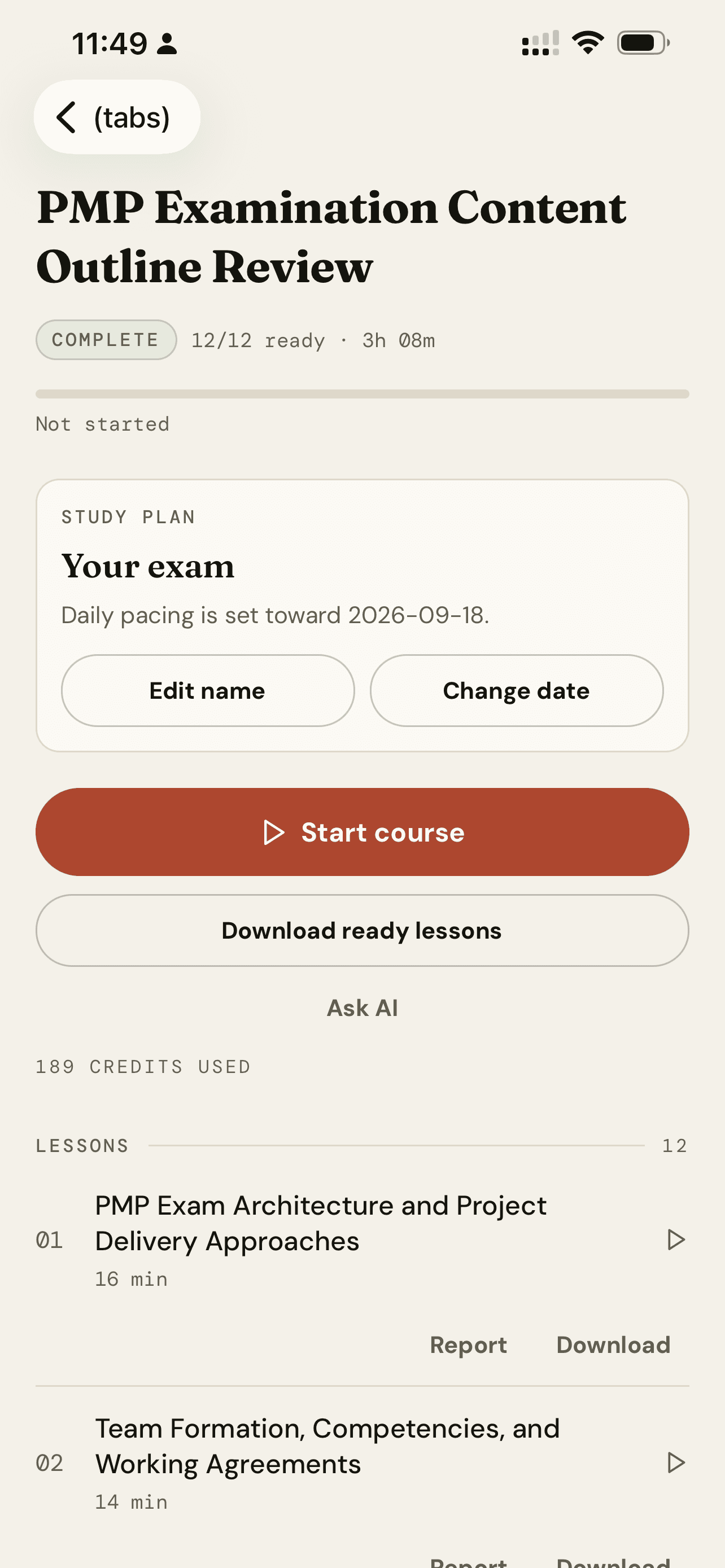
CramClip sits in that third group. You upload a review PDF from your program, or your own notes, and it builds a course of two-host audio lessons, each 15 to 22 minutes. Four questions follow every lesson, and anything you miss comes back as a review card after one, three, seven and fourteen days. Set your exam date and the app paces lessons toward it.
Frequently asked questions
Is the 2026 NCLEX harder than the 2023 version?
Not structurally. NCSBN kept the format and the category percentages, and it upheld both passing standards through March 31, 2029. The main changes are a renamed safety category and refreshed activity statements.
How many questions are on the NCLEX?
Between 85 and 150, in five hours including breaks. Fifteen of them are unscored pretest items that you cannot tell apart from scored ones.
How much does the NCLEX cost?
Registration is $200 in the US through January 31, 2027, and $350 from February 1, 2027. In Canada it rises from 360 to 570 Canadian dollars. Licensure fees from your board are extra.
How soon can I retake the NCLEX?
NCSBN allows a retake 45 days after an attempt, up to eight times a year. Your board may set a longer wait or a lower limit, so check with it before you register again.
What is the best NCLEX study guide?
Start with the free official test plan from NCSBN, then add one question bank with NGN-style items and one content source. Use a guide like this one to decide where your time goes, not as a substitute for practice questions.
Sources
- NCSBN. 2026 NCLEX-RN Test Plan. Exam length, minimum-exam composition, stop rules, clinical judgment model and partial-credit methods.
- NCSBN. 2026 NCLEX-PN Test Plan.
- NCSBN. NCLEX test plans and effective dates.
- NCSBN. 2025 Annual Meeting exams update: 2023 and 2026 test plan comparison.
- NCSBN. Passing standard.
- NCSBN. Fees and payment, including the February 1, 2027 change.
- NCSBN. Registration.
- NCSBN. Results and retake policy.
- NCSBN. NCLEX FAQs: item formats and scoring.
- NCSBN. Next Generation NCLEX and exam preparation resources.