
The AWS Certified Cloud Practitioner exam, code CLF-C02, has 65 questions, of which 50 count toward your score. You get 90 minutes, it costs $100, and you pass with 700 on a scale of 100 to 1,000. This AWS Cloud Practitioner study guide sets out the four official domains and every task statement in them, explains how the scaled score works, and turns the weights into a four-week plan. It ends with the AWS certification path as it stands in October 2026, which has changed a lot in the past year. Every exam fact was checked against AWS's own exam guide and certification pages on October 15, 2026.
CLF-C02 exam at a glance
| Item | Detail |
|---|---|
| Exam code | CLF-C02 |
| Category | Foundational |
| Questions | 65: 50 scored and 15 unscored |
| Question types | Multiple choice (one of four) and multiple response (two or more of five or more) |
| Time | 90 minutes |
| Cost | $100, plus taxes and currency conversion where they apply |
| Passing score | 700 on a 100 to 1,000 scale |
| Delivery | Pearson VUE test center or online proctored |
| Languages | 12, including English, Japanese, Korean and both Chinese scripts |
| Valid for | 3 years |
CLF-C02 is still the current version, and AWS has not announced a successor. The only scheduled change is that the Italian and German versions retire after December 31, 2026.
AWS writes the exam for people with up to six months of exposure to AWS, and says that exposure is not required. Its own examples of who should take it include sales, marketing, product and project management roles. The exam guide lists what is out of scope: coding, designing cloud architecture, troubleshooting, implementation, and load and performance testing. You need to know what services do and when to use them, not how to build with them.
How scoring works
Fifteen of the 65 questions are unscored. AWS uses them to test questions for future exams, and they are not marked, so you cannot tell which ones they are. Answer every question as if it counts.
Your result is a scaled score from 100 to 1,000, and 700 passes. Scaling lets AWS compare results across exam forms that differ slightly in difficulty, so 700 is not the same as 70% correct. The exam is compensatory. You do not have to pass each domain, only the exam as a whole. A strong result in Security and Compliance can carry a weaker one in Billing.
Two rules matter on the day. Unanswered questions are scored as wrong, and there is no penalty for guessing. So never leave a question blank. Your score report may show how you did in each section, but AWS itself advises caution in reading that section-level feedback, because some sections have few questions.
The four domains in this AWS Cloud Practitioner study guide
AWS weights the four domains by share of scored content. Multiplying by the 50 scored questions gives a rough idea of how many questions each domain contributes. These counts are our approximations, not AWS figures.
Domain 1: Cloud Concepts (24%)
Four task statements. 1.1 Define the benefits of the AWS Cloud, such as global reach, high availability, elasticity and agility. 1.2 Identify design principles, which means the six pillars of the Well-Architected Framework: operational excellence, security, reliability, performance efficiency, cost optimization and sustainability. 1.3 Understand the benefits of and strategies for migration, including the AWS Cloud Adoption Framework. 1.4 Understand cloud economics: fixed versus variable costs, licensing models such as bring your own license, rightsizing and economies of scale.
Domain 2: Security and Compliance (30%)
Four task statements. 2.1 The shared responsibility model, including how the split shifts between services such as Amazon EC2, Amazon RDS and AWS Lambda. 2.2 Security, governance and compliance concepts: encryption in transit and at rest, AWS Artifact for compliance reports, and CloudWatch, CloudTrail and AWS Config for monitoring and auditing. 2.3 Access management: IAM users, groups and policies, least privilege, MFA, IAM Identity Center and protecting the root user. 2.4 Security services and resources, such as AWS WAF, AWS Shield, Amazon GuardDuty and Trusted Advisor.
Domain 3: Cloud Technology and Services (34%)
The largest domain has eight task statements. 3.1 Ways to deploy and operate: the console, APIs, SDKs, the CLI and infrastructure as code. 3.2 Global infrastructure: Regions, Availability Zones and edge locations, and when to use more than one Region. 3.3 Compute, from EC2 instance types to containers and serverless options like Fargate and Lambda. 3.4 Databases, including RDS, Aurora, DynamoDB and ElastiCache. 3.5 Networking: VPC components, security groups, network ACLs, Route 53, VPN and Direct Connect. 3.6 Storage: S3 storage classes, EBS, EFS, FSx and AWS Backup. 3.7 AI, machine learning and analytics services, such as SageMaker AI, Lex, Athena, Kinesis and Glue. 3.8 Other in-scope categories, including messaging, developer tools, end-user computing and IoT.
AWS publishes separate lists of in-scope and out-of-scope services alongside the exam guide. Check them before you spend time on a service your course mentions only in passing.
Domain 4: Billing, Pricing and Support (12%)
Three task statements. 4.1 Pricing models: On-Demand, Reserved Instances, Spot, Savings Plans and dedicated options, plus data transfer costs. 4.2 Billing and cost tools: AWS Budgets, Cost Explorer, the Pricing Calculator, consolidated billing in AWS Organizations and cost allocation tags. 4.3 Technical resources and Support options. The current guide names Basic Support, Business Support+, Enterprise Support and AWS Unified Operations, so check that your course uses the same plan names.
A four-week study plan
The domain weights in this AWS Cloud Practitioner study guide suggest where your time goes. Give the two largest domains a week each, and pair the smaller ones with review and practice.
- Week 1Cloud Concepts, plus global infrastructure from Domain 3.
- Week 2Security and Compliance: shared responsibility, IAM, security services.
- Week 3Cloud Technology and Services: compute, databases, network, storage, AI and analytics.
- Week 4Billing and Support, the Official Practice Exam, then your weakest tasks.
Most days, one focused session is enough. Read or listen to one topic, answer a few questions on it, and then revisit what you missed from earlier days. Short daily sessions spread across four weeks will beat two long weekends, because the spacing does part of the work.
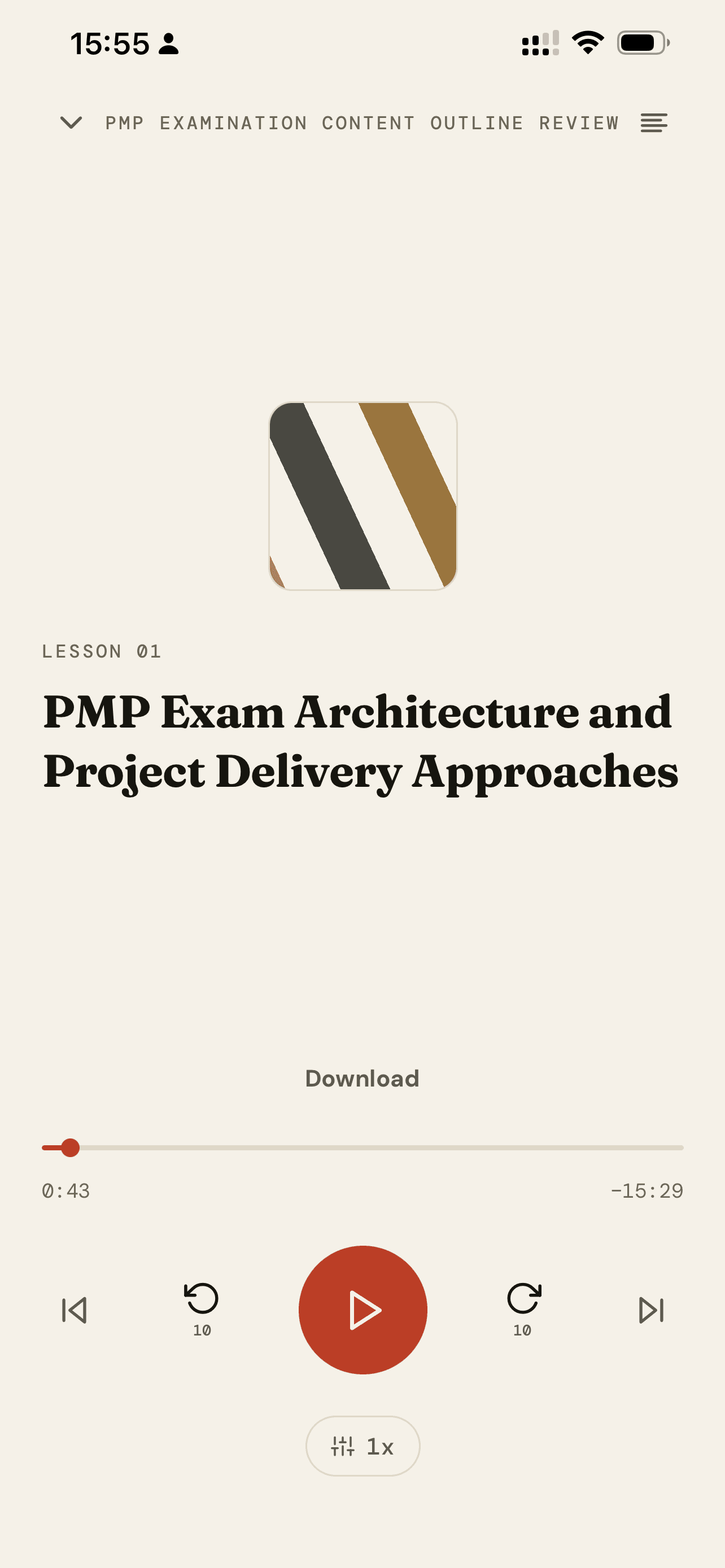
This is where CramClip fits, especially if you are not an engineer and would rather not open a console. Upload the AWS exam guide and your course notes, and CramClip turns them into a series of two-host audio lessons of 15 to 22 minutes each, for the commute or the gym (how a PDF becomes a podcast). Four questions follow every lesson. Anything you miss comes back as a review card after one, three, seven and fourteen days. Set your exam date and it paces the lessons to finish in time.
AWS practice exams
No AWS Cloud Practitioner study guide, this one included, replaces timed practice. AWS’s own exam prep plan on Skill Builder starts with an Official Practice Question Set to get used to the style, and an Official Pretest to find gaps. It ends with the AWS Certification Official Practice Exam to check readiness. Take the official exam first, because it is written to the same guide as the real one. Third-party mock exams add volume, but quality varies, so check any answer that disagrees with AWS documentation.
The four questions after each CramClip lesson are recall checks on that lesson, not full mock exams. Use both: lessons and spaced review to learn the material, and practice exams to rehearse the format under time.
The AWS certification path in 2026
Once you pass, every way forward is open. AWS groups its certifications into tiers, and the lineup changed a lot in 2025 and 2026.
- FoundationalCloud Practitioner; AI Practitioner.
- AssociateSolutions Architect, Developer, Data Engineer, Machine Learning Engineer, CloudOps Engineer.
- ProfessionalSolutions Architect, DevOps Engineer, Generative AI Developer.
- SpecialtySecurity; Advanced Networking until December 31, 2026.
AWS also offers a new AI Business Strategist certification in a separate Business category. It is in beta, with 85 questions in 170 minutes, priced at $50 during the beta and $100 after. It does not test knowledge of AWS services.
What changed in 2025 and 2026
- SysOps Administrator became CloudOps Engineer. The Associate exam is now SOA-C03, and the new name applies only to people who pass that version.
- Machine Learning – Specialty retired. The last exam day was March 31, 2026. Holders stay certified for three years from the date they earned it.
- Advanced Networking – Specialty retires after December 31, 2026.
- Generative AI Developer – Professional is new: 75 questions, 180 minutes, $300.
- Version updates are in progress. Registration for Solutions Architect – Professional SAP-C03 and Developer – Associate DVA-C03 opens October 27, 2026. The last day for SAP-C02 is November 16, 2026, and for DVA-C02 it is November 30, 2026. Machine Learning Engineer – Associate moved to MLA-C02, with the English MLA-C01 ending on September 28, 2026.
Where to go after Cloud Practitioner
AWS's Cloud Practitioner page points to the Solutions Architect, Developer and SysOps Associate certifications as common next steps; SysOps is now CloudOps Engineer. If AI is your direction, AI Practitioner is the other Foundational exam. Associate exams such as Developer and CloudOps Engineer run 130 minutes with 65 questions and cost $150. Once you hold one AWS certification, AWS gives you a 50% discount on other AWS certification exams.
Frequently asked questions
Is CLF-C02 still the current Cloud Practitioner exam?
Yes, as of October 15, 2026. AWS has not announced a successor. Only the Italian and German versions retire after December 31, 2026.
What is the passing score for AWS Cloud Practitioner?
A scaled score of 700 on a range of 100 to 1,000. The exam is compensatory, so you need to pass overall, not each domain.
How many questions count on the exam?
Fifty of the 65. The other 15 are unscored questions that AWS is testing for future use, and they are not marked.
How long is the certification valid?
Three years. You can recertify through the AWS Cloud Quest recertification game, by passing the latest Cloud Practitioner exam, or by passing an Associate or Professional exam.
Should I take Cloud Practitioner or AI Practitioner first?
Both are Foundational. Cloud Practitioner is the broad base in cloud concepts, security, services and billing. AI Practitioner focuses on AI, machine learning and generative AI on AWS. Pick the one closest to your work.
Sources
- AWS. AWS Certified Cloud Practitioner (CLF-C02) exam guide, including the domain pages and in-scope service lists.
- AWS. AWS Certified Cloud Practitioner.
- AWS. AWS Certification exams.
- AWS. AWS Certified AI Practitioner.
- AWS. AWS Certified CloudOps Engineer – Associate.
- AWS. AWS Certified Developer – Associate.
- AWS. AWS Certified Machine Learning Engineer – Associate.
- AWS. AWS Certified Solutions Architect – Professional.
- AWS. AWS Certified DevOps Engineer – Professional.
- AWS. AWS Certified Generative AI Developer – Professional.
- AWS. AWS Certified Machine Learning – Specialty.
- AWS. AWS Certified AI Business Strategist.