
Most NCLEX study plans split your weeks by textbook chapter or by whatever a question bank happens to sell. NCSBN, the organization that writes the exam, publishes exactly how the test is weighted, so this NCLEX study plan does the same: tell it your exam date and how many hours you can give each day, and it spreads those hours across the eight client-need categories in proportion to the official 2026 test plan, with spaced review built into every week.
Free tool · no sign-up
Build your NCLEX study plan
Loading your calendar…
How this NCLEX study plan is built
The generator makes three decisions for you, and each one is based on something you can check.
The weights come from NCSBN. The 2026 NCLEX-RN and NCLEX-PN test plans each list a percentage range for every client-need category, and the chart in each plan prints a single midpoint for every range. The tool uses those midpoints. For the RN exam, that means Management of Care gets 18% of your category time, Pharmacological and Parenteral Therapies gets 16%, and Health Promotion, Psychosocial Integrity and Basic Care get 9% each. Mark a category as one of your weakest and it gets a quarter more time before everything is rebalanced to 100%.
The weeks are split into three phases. Roughly the first 40% of your time is foundation work, where you learn content by category and answer questions on what you just covered. The next 40% is application: mixed-category questions and case studies. The last 20%, and never less than one week, is final review with timed, full-length practice.
- FoundationContent by category, with practice questions on each block.
- ApplicationMixed questions and case studies; read every rationale.
- Final reviewTimed full-length practice, then your weakest categories.
- Exam eveNo new material. Check your ID and Authorization to Test.
Every week after the first sets aside about a fifth of its hours for mixed review of earlier weeks' categories. That is the spacing effect at work, and it is the reason the plan is not a simple checklist you finish once.
One honest limit: the exam is computerized adaptive, between 85 and 150 items, and the mix you get can shift by a few points per category. The weights are a guide for where your time goes, not a forecast of your exact questions.
What's on the NCLEX in 2026, and what changed
A new test plan took effect on April 1, 2026, and runs until March 31, 2029. If you studied from 2023 material, the good news is that the category percentages did not change. The one visible difference is a rename: "Safety and Infection Control" is now "Safety and Infection Prevention and Control." NCSBN also refreshed the activity statements under each category. For question formats, stop rules, scoring and fees, see our NCLEX study guide.
| Client-need category | NCLEX-RN | NCLEX-PN |
|---|---|---|
| Management of Care (RN) / Coordinated Care (PN) | 15–21% | 18–24% |
| Safety and Infection Prevention and Control | 10–16% | 10–16% |
| Health Promotion and Maintenance | 6–12% | 6–12% |
| Psychosocial Integrity | 6–12% | 9–15% |
| Basic Care and Comfort | 6–12% | 7–13% |
| Pharmacological (and Parenteral) Therapies | 13–19% | 10–16% |
| Reduction of Risk Potential | 9–15% | 9–15% |
| Physiological Adaptation | 11–17% | 7–13% |
Both exams run from 85 to 150 items within five hours, including breaks. Every exam includes three clinical judgment case studies of six items each, and 15 unscored pretest items you cannot tell apart from the rest.
How to study for the NCLEX: five rules the research supports
Test yourself instead of rereading
In a well-known experiment, Roediger and Karpicke had students either reread a passage or practise recalling it. Five minutes later, the rereaders did slightly better. One week later, the group that had tested itself recalled 61% of the material, against 40% for the group that had reread it four times. The rereaders also felt more confident they would remember it. If your NCLEX study schedule is mostly rereading notes, it will feel productive and be less so.
Tested after 5 minutes
Tested after 1 week
Space your reviews out
A meta-analysis by Cepeda and colleagues pooled 839 assessments from 317 experiments and found that spreading study sessions apart beats massing them together. It also found that the further away the test is, the longer the gaps between reviews should be. That is why the generator schedules review blocks every week instead of saving all your review for the end.
Put the hours where the points are
Management of Care and Pharmacological and Parenteral Therapies together make up roughly a third of the NCLEX-RN. A plan that gives pharmacology the same time as Basic Care and Comfort is leaving points on the table.
Practise clinical judgment in case-study form
Eighteen items on every exam come from case studies, and they ask you to recognize cues, analyze them, prioritize hypotheses and evaluate outcomes. The application phase is where you should be doing case studies regularly, not just single questions.
Rest the day before
The exam can last up to five hours. The plan always leaves the last day free, and the final week is lighter on new material.
Sample NCLEX study schedules: 4, 8 and 12 weeks
These examples come from the same generator, assuming two hours on weekdays, four hours on Saturday and Sunday off. Use them to sanity-check your own plan, or as a starting point if you prefer a printed schedule.
8-week NCLEX study plan
Eight weeks is the most common choice, and it gives you 112 hours at this pace. Three weeks of foundation, three of application and two of final review leave room for two or three full-length practice exams.
| Category | Foundation 3 wk | Application 3 wk | Final review 2 wk | Total |
|---|---|---|---|---|
| Management of Care | 6.5 h | 6 h | 3 h | 15.5 h |
| Safety and Infection Prevention and Control | 4.5 h | 4.5 h | 2 h | 11 h |
| Health Promotion and Maintenance | 3.5 h | 3 h | 1.5 h | 8 h |
| Psychosocial Integrity | 3 h | 3 h | 1.5 h | 7.5 h |
| Basic Care and Comfort | 3 h | 3 h | 1.5 h | 7.5 h |
| Pharmacological and Parenteral Therapies | 6 h | 5 h | 3 h | 14 h |
| Reduction of Risk Potential | 4.5 h | 4 h | 2 h | 10.5 h |
| Physiological Adaptation | 5 h | 4.5 h | 2.5 h | 12 h |
| Mixed review and timed practice exams | 6 h | 9 h | 11 h | 26 h |
| All study time | 42 h | 42 h | 28 h | 112 h |
12-week NCLEX study plan
Twelve weeks suits students who are still working, or anyone starting from a weak baseline. You get 168 hours, and five weeks of foundation work before mixed practice begins.
| Category | Foundation 5 wk | Application 5 wk | Final review 2 wk | Total |
|---|---|---|---|---|
| Management of Care | 10.5 h | 10 h | 3 h | 23.5 h |
| Safety and Infection Prevention and Control | 7.5 h | 7.5 h | 2 h | 17 h |
| Health Promotion and Maintenance | 5.5 h | 4.5 h | 1.5 h | 11.5 h |
| Psychosocial Integrity | 5 h | 5 h | 1.5 h | 11.5 h |
| Basic Care and Comfort | 5 h | 5 h | 1.5 h | 11.5 h |
| Pharmacological and Parenteral Therapies | 9.5 h | 8.5 h | 3 h | 21 h |
| Reduction of Risk Potential | 7 h | 6.5 h | 2 h | 15.5 h |
| Physiological Adaptation | 8 h | 8 h | 2.5 h | 18.5 h |
| Mixed review and timed practice exams | 12 h | 15 h | 11 h | 38 h |
| All study time | 70 h | 70 h | 28 h | 168 h |
4-week NCLEX study plan
Four weeks is tight but workable if you finished school recently and your practice scores are already solid. Most published plans run six weeks or longer, so treat this one as a sprint, not a default.
| Category | Foundation 2 wk | Application 1 wk | Final review 1 wk | Total |
|---|---|---|---|---|
| Management of Care | 4.5 h | 2 h | 1.5 h | 8 h |
| Safety and Infection Prevention and Control | 3.5 h | 1 h | 1.5 h | 6 h |
| Health Promotion and Maintenance | 2.5 h | 1 h | 0.5 h | 4 h |
| Psychosocial Integrity | 2 h | 1 h | 1 h | 4 h |
| Basic Care and Comfort | 2 h | 1 h | 1 h | 4 h |
| Pharmacological and Parenteral Therapies | 4 h | 2 h | 1 h | 7 h |
| Reduction of Risk Potential | 3 h | 1.5 h | 1 h | 5.5 h |
| Physiological Adaptation | 3.5 h | 1.5 h | 1 h | 6 h |
| Mixed review and timed practice exams | 3 h | 3 h | 5.5 h | 11.5 h |
| All study time | 28 h | 14 h | 14 h | 56 h |
If you work 12-hour shifts, set weekday hours low and put more time on your days off. The weekly totals matter more than which days they fall on.
How to pass the NCLEX when you don't have time to sit and study
Most candidates are short on desk time, not total time. Count the minutes you spend commuting, at the gym, cooking or walking the dog. Across a week, that time often adds up to more than one of your desk sessions.
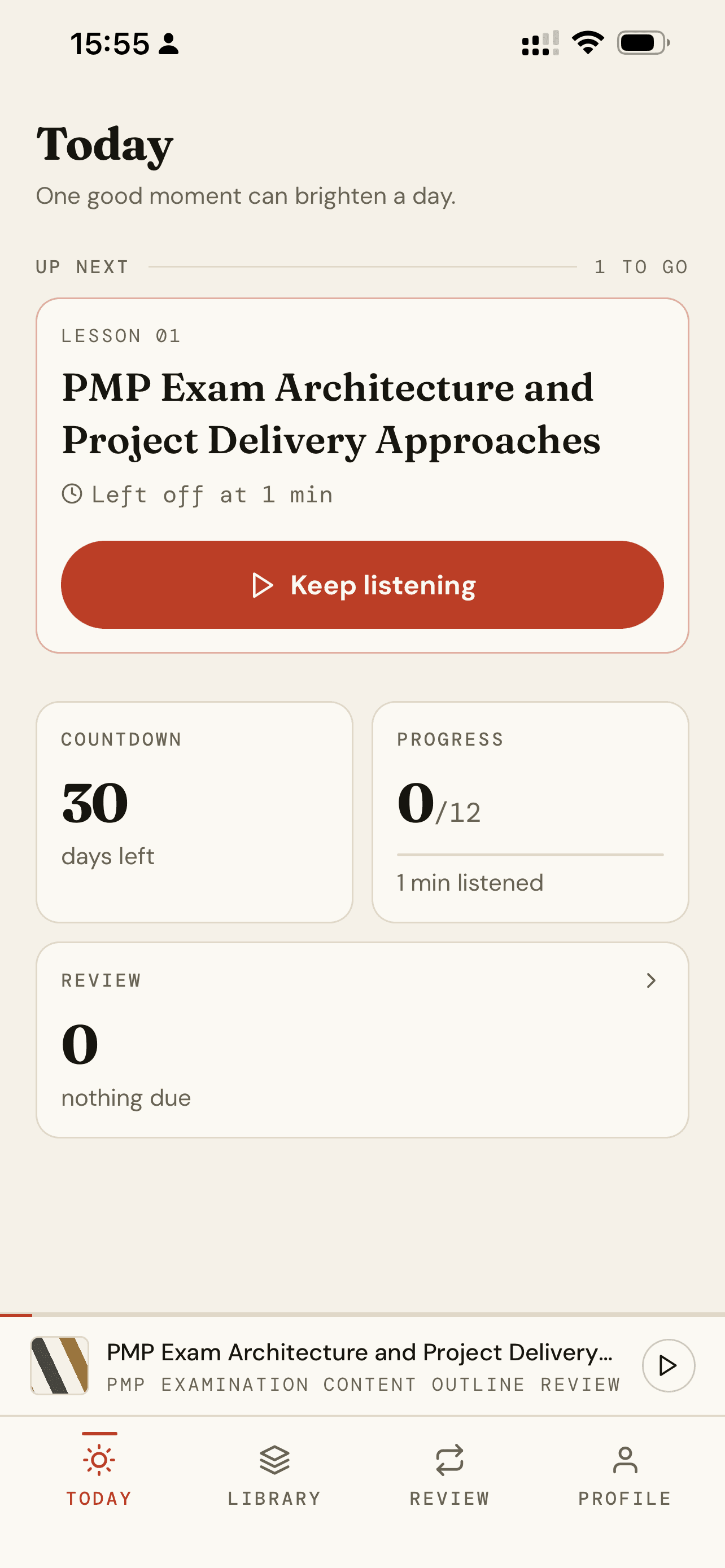
That time is where CramClip fits. You upload a review PDF from your program, or your own notes, and it turns them into a short course of two-host audio lessons, each 15 to 22 minutes. After every lesson you answer four quick questions. Anything you miss becomes a review card that comes back one, three, seven and fourteen days later, so listening becomes active recall instead of background noise. The Today screen counts down to your exam date and tells you how many lessons to finish each day.
Your last seven days
Stop adding new content in the final week. Take one or two timed practice exams under real conditions, review only the categories that keep costing you points (our NCLEX cheat sheet covers the lab values and drug stems), and confirm the boring details: your Authorization to Test, your ID, the test center and how long it takes to get there. Leave the day before the exam completely free.
After the exam, some boards offer unofficial Quick Results for a fee about two business days later. Official results come from your nursing regulatory body. If you need to retake, the waiting period is 45 days, and some boards are stricter.
Frequently asked questions
How many hours a day should I study for the NCLEX?
Most published plans range from two to five hours a day over six to twelve weeks. Consistency matters more than marathon days: spaced sessions beat cramming. Use the generator above to see what your hours add up to in each category.
Did the NCLEX test plan change in 2026?
Yes. A new test plan took effect on April 1, 2026, and runs until March 31, 2029. The category percentages are the same as in 2023. The main visible change is that Safety and Infection Control is now called Safety and Infection Prevention and Control.
Is four weeks enough to study for the NCLEX?
It can be for recent graduates with strong practice scores, but most published plans run six weeks or more. The generator will build a four-week plan and flag anything shorter than three weeks as compressed.
Should NCLEX-PN candidates use a different study plan?
Yes. The PN test plan weights categories differently: Coordinated Care is 18 to 24 percent and Psychosocial Integrity is 9 to 15 percent, for example. Switch the generator to NCLEX-PN and it uses the PN weights.
What should I study first?
Take a baseline practice test, then start with the categories that are both heavily weighted and weak for you. Mark those as your weakest areas in the generator and they get extra time.
Sources
- 2026 NCLEX-RN Test Plan, NCSBN. Effective April 2026.
- 2026 NCLEX-PN Test Plan, NCSBN.
- NCLEX test plans and effective dates, NCSBN.
- NCSBN 2025 Annual Meeting exams update: 2023 and 2026 test plan comparison.
- NCLEX results and retake policy, NCSBN.
- Roediger, H. L., & Karpicke, J. D. (2006). Test-enhanced learning: Taking memory tests improves long-term retention. Psychological Science, 17(3), 249–255.
- Cepeda, N. J., et al. (2006). Distributed practice in verbal recall tasks: A review and quantitative synthesis. Psychological Bulletin, 132(3), 354–380.