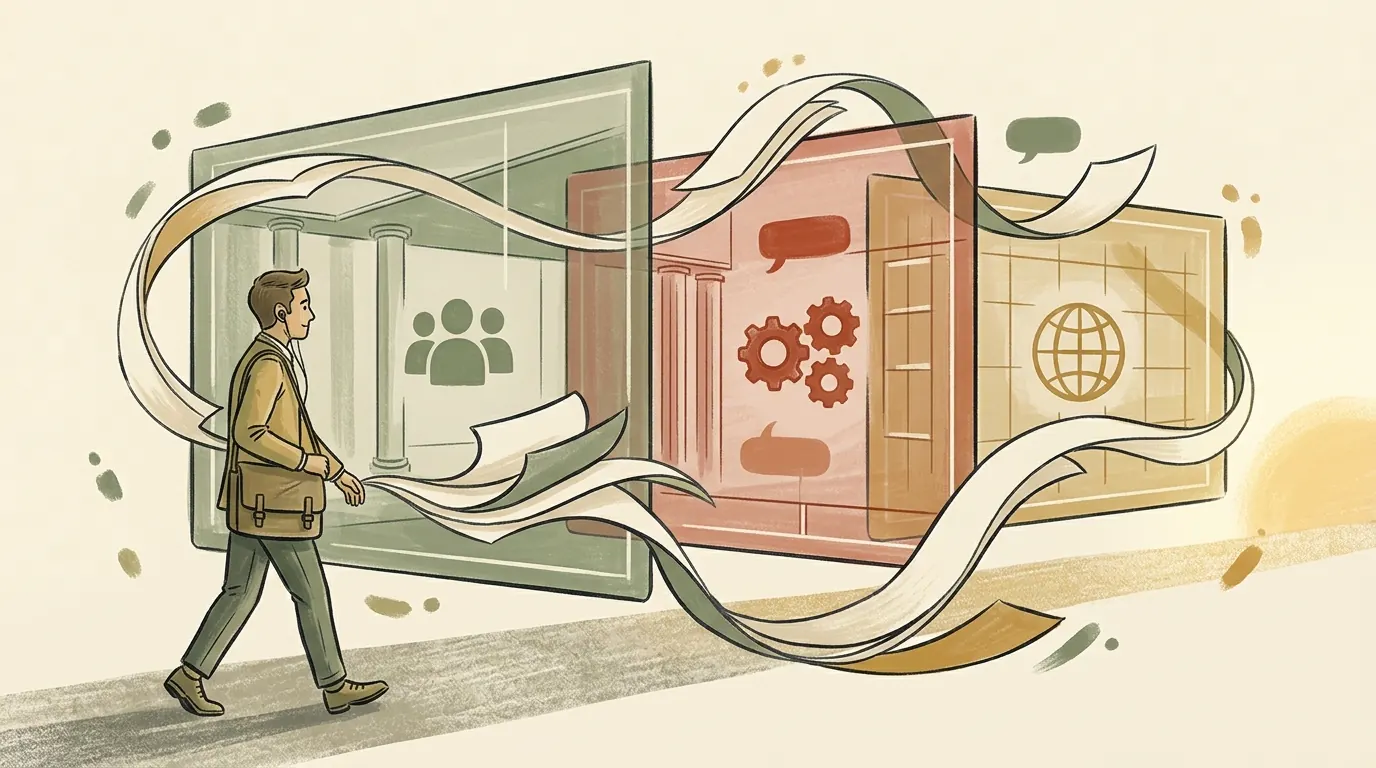
Since July 2026, the PMP has been built on a new PMP Exam Content Outline. It has three domains, weighted People 33%, Process 41% and Business Environment 26%, and 26 tasks in total, down from 35. About 40% of the questions are set in a predictive context and about 60% in agile or hybrid ones. If a guide still quotes 42%, 50% and 8%, it is describing the outline that was retired in July. Below you will find every domain and task, exactly what changed, and how to turn the weights into a study plan. All figures were checked against PMI's own PDF on October 15, 2026.
What the PMP exam content outline is
The Examination Content Outline, or ECO, is PMI's blueprint for the exam. It comes out of a job task analysis, a study of what practising project managers actually do, and it sets out what the exam is allowed to test. PMI states that every exam covers every task, and that each exam keeps to the published domain percentages.
The outline has three levels. Domains are the broad areas of the job. Tasks are the responsibilities within each domain. Enablers are examples of the work behind each task, and PMI is clear that they are illustrative, not a complete list.
One thing the ECO is not: it is not the PMBOK Guide. PMI notes that the two differ noticeably and that the exam is not written to any single book. The ECO tells you what is tested; your course and references tell you how to learn it.
The three domains and their weights
| Domain | Weight | Tasks | About this many of the 170 scored questions |
|---|---|---|---|
| People | 33% | 8 | 56 |
| Process | 41% | 10 | 70 |
| Business Environment | 26% | 8 | 44 |
The question counts are our approximations from the percentages. The exam has 180 questions, but 10 are unscored pretest items you cannot identify, so plan around the weights rather than exact counts.
The approach mix runs across all three domains. Roughly 40% of questions assume a predictive, plan-driven project, and the remaining 60% are split between adaptive (agile) and hybrid. That is a shift from the old outline, which was about half and half.
People
Process
Business Environment
All 26 tasks in the PMP exam content outline
Task titles are PMI's own. The notes after each table are our summary of what the task covers.
People: 8 tasks, 33%
| # | Task |
|---|---|
| 1 | Develop a common vision |
| 2 | Manage conflicts |
| 3 | Lead the project team |
| 4 | Engage stakeholders |
| 5 | Align stakeholder expectations |
| 6 | Manage stakeholder expectations |
| 7 | Help ensure knowledge transfer |
| 8 | Plan and manage communication |
Half of the People domain is now about stakeholders and communication. Expect situational questions where the right answer is a conversation, not a document: aligning people on a shared vision, resolving conflict before it escalates, and making sure knowledge does not leave with a team member.
Process: 10 tasks, 41%
| # | Task |
|---|---|
| 1 | Develop an integrated project management plan and plan delivery |
| 2 | Develop and manage project scope |
| 3 | Help ensure value-based delivery |
| 4 | Plan and manage resources |
| 5 | Plan and manage procurement |
| 6 | Plan and manage finance |
| 7 | Plan and optimize quality of products and deliverables |
| 8 | Plan and manage schedule |
| 9 | Evaluate project status |
| 10 | Manage project closure |
Process is still the largest domain, but it is leaner. Finance is now its own task and includes quantifying financial allocations for risk and contingency. Scheduling sits next to agile estimation, so story points and milestones appear side by side. Evaluating status is where metrics, charts and earned value show up, which matters because the new graphic-based questions ask you to read them.
Business Environment: 8 tasks, 26%
| # | Task |
|---|---|
| 1 | Define and establish project governance |
| 2 | Plan and manage project compliance |
| 3 | Manage and control changes |
| 4 | Remove impediments and manage issues |
| 5 | Plan and manage risk |
| 6 | Continuous improvement |
| 7 | Support organizational change |
| 8 | Evaluate external business environment changes |
This is the domain that grew. Governance, compliance, change control, issues and risk all lived under Process in the 2021 outline and now sit here. Compliance explicitly includes areas such as security, health and safety, and sustainability.
What changed from the 2021 outline
| 2021 outline | July 2026 outline | |
|---|---|---|
| Domain weights | People 42%, Process 50%, Business Environment 8% | People 33%, Process 41%, Business Environment 26% |
| Tasks | 35 (14, 17 and 4) | 26 (8, 10 and 8) |
| Approach mix | About half predictive | About 40% predictive, 60% agile or hybrid |
| Questions | 180 | 180, of which 170 scored and 10 pretest |
| Time | 230 minutes | 240 minutes |
| Breaks | Two 10-minute breaks | Two 10-minute breaks; no going back after a break |
Business Environment tripled, but mostly by moving
The jump from 8% to 26% looks dramatic. Comparing the two task lists shows that most of it is reorganization: risk, change control, governance, issue management and compliance moved from Process into Business Environment. There is new emphasis, such as supporting organizational change and watching the external environment, but it is not 18 points of brand-new material. If you studied risk and change control before, that knowledge still counts. It is just scored under a different heading.
New question formats
The 2026 exam adds case or scenario sets, where several questions hang off one situation, and graphic-based questions that ask you to interpret charts and graphs. Multiple choice and multiple response remain, and matching, point-and-click and pull-down items appear in the computer-based version.
AI and sustainability
PMI names artificial intelligence and sustainability among the trends that shaped this outline. Sustainability appears in specific tasks, including quality and compliance. AI is part of the context rather than a task of its own, so be wary of prep materials that promise a large block of AI questions.
Timing and breaks
You have 240 minutes for 180 questions. The first 10-minute break comes after the case-study section and the second roughly halfway through the independent questions. Once you start a break, you cannot return to the questions before it.
How to study for the PMP using the exam content outline
Turn weights into hours. Decide how many hours you can study, then split them by domain. For an 80-hour plan, that comes out to roughly 26 hours on People, 33 on Process and 21 on Business Environment. Then weight within each domain by how confident you already feel.
Use the 26 tasks as a checklist. Print PMI's PDF and mark each task red, amber or green. Red tasks get study time first, and amber tasks get practice questions.
Practise the new formats. Look for practice questions with case sets and charts. Reading an earned value S-curve or a burndown chart quickly is now a scored skill. Know the earned value formulas behind those charts well enough to read them at a glance; our PMP formulas cheat sheet works through each one.
Use time you can't spend at a desk. CramClip turns the ECO and your course notes into a series of short two-host audio lessons, quizzes you after each one, and brings back what you missed on a one, three, seven and fourteen day schedule. Set your exam date and it builds a daily plan to get there. It teaches from the material you upload; it is not a PMI course and does not count toward your 35 contact hours. For eligibility, the application and a week-by-week plan, see our PMP exam prep guide.
Frequently asked questions
Which PMP exam content outline is in effect now?
The July 2026 outline. PMI launched the new exam in July 2026, and the 2021 outline is retired.
How many tasks are in the PMP exam content outline?
Twenty-six: eight in People, ten in Process and eight in Business Environment. The 2021 outline had 35.
Is the PMP exam 50% agile?
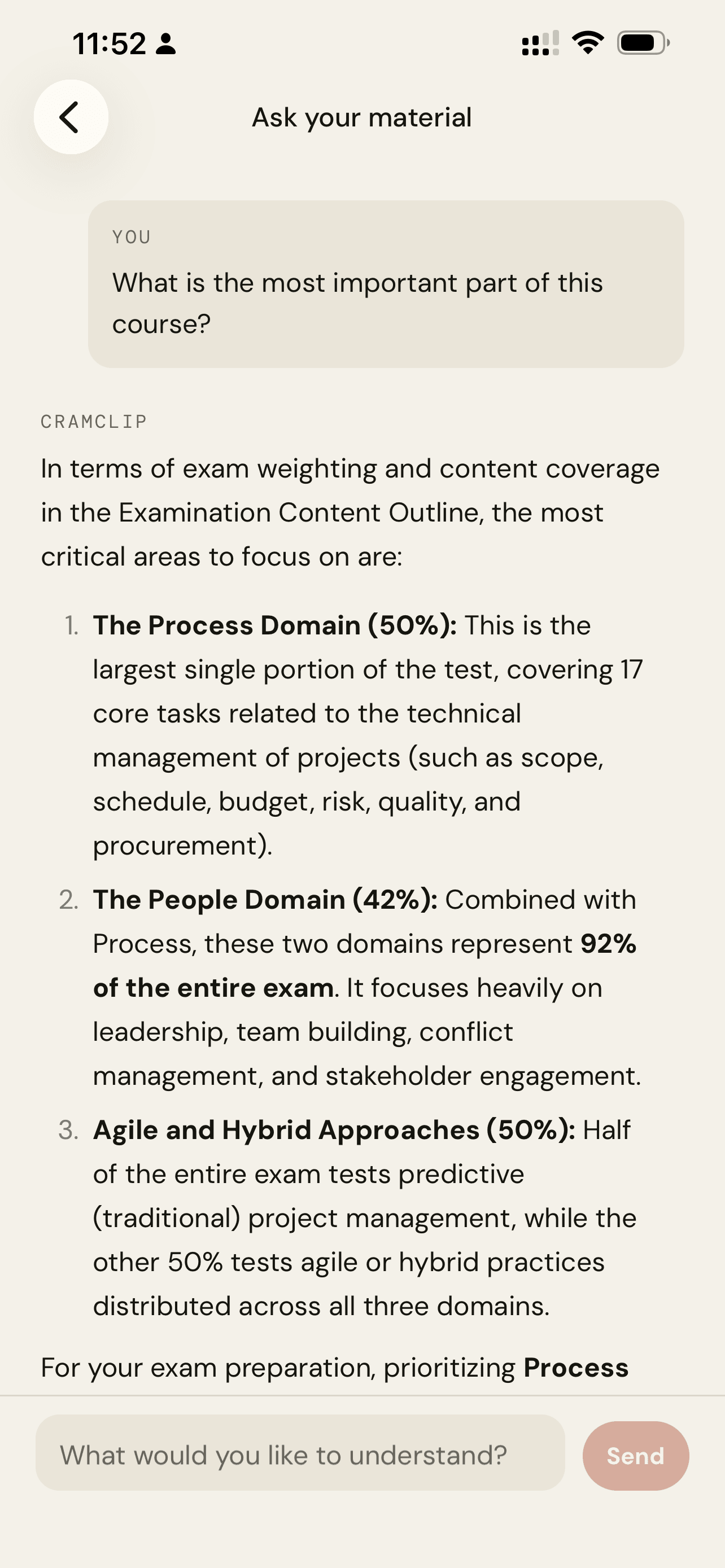
No. About 40% of questions are predictive and about 60% are agile or hybrid combined. The 2021 outline was roughly half predictive.
How long is the new PMP exam?
You have 240 minutes for 180 questions, 170 of them scored, with two 10-minute breaks. You cannot go back to earlier questions once a break starts.
Do I still need the PMBOK Guide?
The exam content outline tells you what is tested, not how to learn it. PMI lists reference materials but says the exam is not based on any single text, so use the PMBOK Guide alongside a course and practice questions rather than on its own.
Sources
- PMI. Project Management Professional (PMP) Examination Content Outline – July 2026.
- PMI. The new PMP exam.
- PMI. PMP Examination Content Outline, January 2021 edition (copy hosted by a training provider).
- PMI. Certification Handbook.
- Course Report. What's changing on the PMP exam in July 2026.